GymAdapt is free to use. No trial, no subscription needed.
- An AI plan for your goal, days and equipment
- Unlimited workouts and set logging
- A video for every exercise
- Weights that adjust for you (first 30 days)
One-rep max (1RM) calculator
Enter the weight and reps of a hard set you've already done. You get your estimated max and the training weight at every percentage.
| % of 1RM | Weight | Reps at this weight (approx.) | Use it for |
|---|
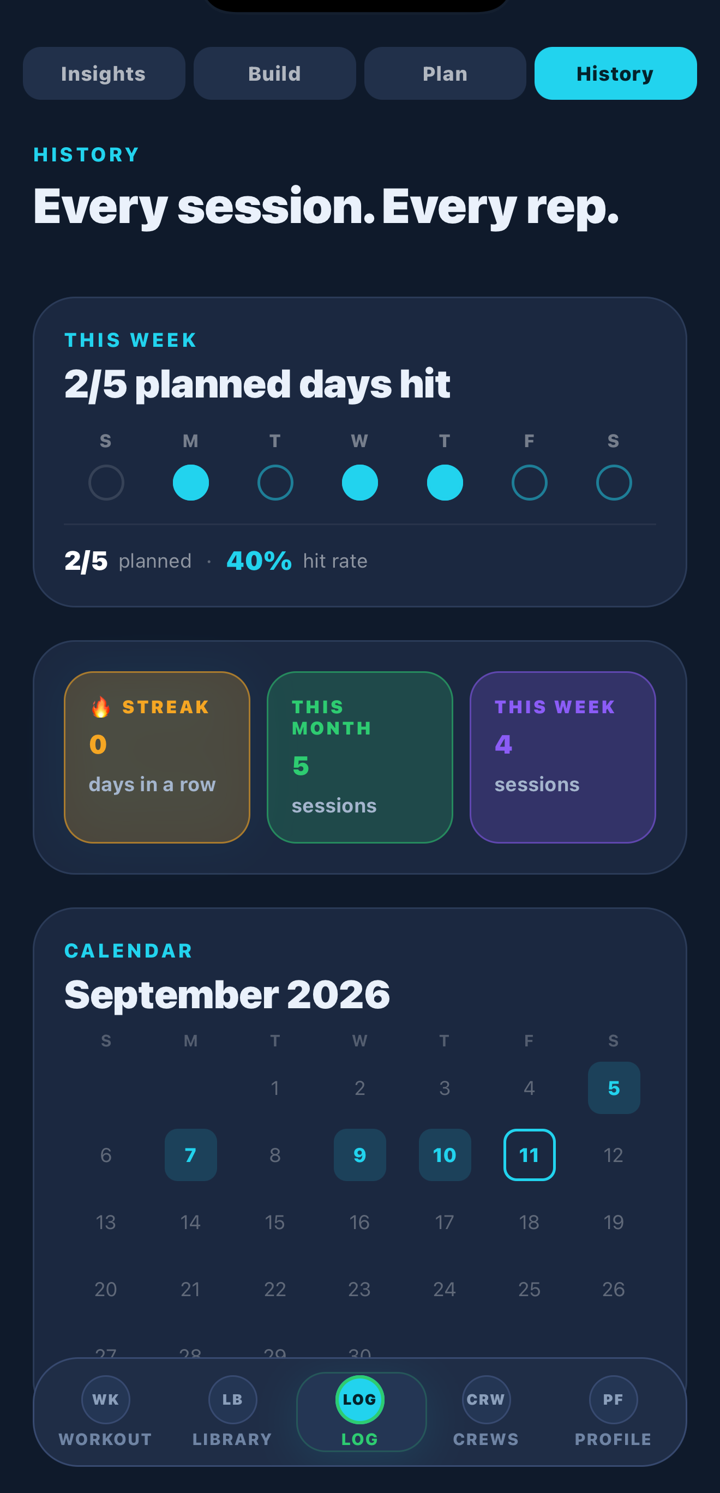
Logging on your phone? GymAdapt estimates your 1RM from every set you log, charts it over time and, for your first 30 days, sets your next working weights from it. Free on iPhone. →
How the calculator works
It uses the Epley formula: 1RM = weight × (1 + reps ÷ 30). A set of 100 kg for 5 reps gives an estimated 1RM of about 117 kg. Above 10 reps the estimate gets less reliable, so the calculator stops at 12. Estimates also vary by person and by lift: people with a lot of muscular endurance tend to be overestimated, and the formula is usually closest on the squat, bench press and deadlift.
How to use your numbers
- Most strength work sits at 80–90% of your 1RM, for 3–6 reps.
- Most muscle-building work sits at 65–80%, for 6–15 reps.
- Use 90% and above sparingly, and only with a spotter or safety pins.
- Re-estimate every 6–8 weeks from a fresh hard set, not from a max attempt.
An estimate is not a target. Never attempt a true max alone, and stop any set where your form breaks down.
Questions people ask
How accurate is a 1RM calculator?
From a hard set of 2–6 reps, the estimate is usually within about 5% of a tested max. Above 10 reps the error grows, so use a heavier set if you have one.
Which 1RM formula is best?
Epley and Brzycki are the most used. They agree exactly at 10 reps; below that, Epley reads a few percent higher. Neither is best for everyone: pick one and use it consistently so your numbers stay comparable.
Should beginners test their 1RM?
There is no need. A true max attempt adds risk and tells you little in your first year. Estimate it from a hard set of 3–6 reps instead.
How often should I recalculate my 1RM?
Every 6–8 weeks, or whenever your working weights start to feel clearly easier.
Your 1RM, updated after every workout
GymAdapt estimates your max from every set you log and turns it into next session's weights. Free on iPhone.
Download on theApp Store